
Retirement Planning Brisbane
Massey Financial Advice
At Massey Financial Advice, we help professionals take control of their financial future through strategic retirement planning and practical financial modelling. Our personalised advice shows you how today’s decisions shape tomorrow’s lifestyle – so you can retire with confidence and peace of mind.
Make Confident Decisions About Your Retirement
Retirement planning is about more than building your superannuation balance. It is about understanding when you can afford to retire, how much income you may have, and what you can do now to improve your future position.
At Massey Financial Advice, we help Brisbane professionals, couples and business owners make informed decisions as they prepare for retirement. Through personalised advice and practical financial modelling, we can help you understand how your superannuation, investments, property, debt and future spending may work together over time.
Our goal is to give you greater clarity around three important questions:
- When can I realistically retire?
- How much income could I have in retirement?
- What changes should I make now to improve my position?
Rather than relying on general rules or assumptions, we build a retirement strategy around your circumstances, goals and preferred lifestyle.



Are You on Track for the Retirement You Want?
As retirement gets closer, it is common to feel uncertain about whether you have done enough.
You may have accumulated superannuation, investments or property, but still be unsure how these assets will translate into a reliable retirement income. You may also be weighing up major decisions, such as whether to:
- retire earlier or continue working;
- reduce your working hours gradually;
- pay down your mortgage;
- contribute more to superannuation;
- sell or retain an investment property;
- help adult children financially;
- downsize your home;
- change your investment strategy;
- make a major purchase before retirement;
- travel during the early years of retirement.
These decisions are often connected. A choice that improves your position in one area may affect your cash flow, tax, investment risk or future flexibility elsewhere.
A structured retirement plan can help you understand these trade-offs before making significant financial decisions.
Retirement Advice for Brisbane Clients in Their 50s and 60s
Many of our retirement-planning clients come to us during their 50s and 60s.
At this stage, retirement may be close enough to feel real, but there is often still time to make meaningful improvements. Your remaining working years may provide an opportunity to strengthen your superannuation, reduce debt, review your investments and prepare for the transition from employment income to retirement income.
You may benefit from retirement advice if you are:
- approximately five to ten years from retirement;
- uncertain whether your current savings will support your preferred lifestyle;
- considering reducing your working hours;
- approaching the age when you can access your superannuation;
- concerned about market volatility close to retirement;
- unsure how to structure your retirement income;
- making decisions about property, debt or major expenses;
- preparing to leave work within the next few years;
- already retired but looking for greater clarity or control.
The earlier you understand your likely position, the more options you may have available.
For more detailed guidance about preparing during the decade before retirement, visit our Ten Years to Retirement page.


What Does Retirement Planning Involve?
A comprehensive retirement plan considers more than your superannuation balance. It brings together the different parts of your financial position and assesses how they may support your future lifestyle.
Your retirement goals
The starting point is understanding what retirement means to you.
This may include:
- the age you would like to retire;
- whether you intend to stop work completely or gradually reduce your hours;
- the lifestyle you want to maintain;
- travel and leisure plans;
- future housing decisions;
- financial support for children or grandchildren;
- major purchases or renovations;
- the legacy you would like to leave.
These goals help determine the level of income and flexibility your strategy needs to provide.
Retirement income planning
Once you stop working, your financial structure changes. Instead of receiving a regular salary, you may need to draw income from superannuation, investments, cash reserves and potentially government entitlements.
We can help you consider how these different sources may work together, how much income may be sustainable over time, and the best way to structure your financial affairs.
Superannuation planning
Your final working years may be an important period for building and structuring your superannuation.
Depending on your circumstances, this may involve reviewing:
- contribution strategies;
- salary sacrifice arrangements;
- personal deductible contributions;
- unused concessional contribution opportunities;
- spouse contribution strategies;
- the suitability of your current superannuation fund;
- investment options within superannuation;
- insurance held through superannuation;
- how and when to move into retirement-phase income streams.
Any recommendations will depend on your eligibility, financial position and the rules applying at the time.
Investment strategy
Your investment strategy should reflect your retirement timeframe, income needs and tolerance for risk.
As retirement approaches, it may be appropriate to review whether your portfolio is still positioned correctly. This does not necessarily mean avoiding growth assets altogether. Retirement may last several decades, so your strategy may still need to support long-term growth while also managing short-term income needs and market risk.
Debt and mortgage planning
Many people approaching retirement are deciding whether to prioritise mortgage repayments, superannuation contributions or other investments.
There is no single answer that suits everyone. The right approach depends on factors such as your interest rate, tax position, available cash flow, superannuation rules, retirement date and need for financial flexibility.
Tax planning
The way your investments, superannuation and retirement income are structured can affect the amount of tax you pay.
Retirement planning may include considering the tax consequences of:
- making superannuation contributions;
- selling investments;
- receiving income from different sources;
- commencing a pension;
- holding assets personally, jointly or through other structures;
- managing capital gains;
- drawing down assets over time.
Age Pension and government entitlements
Some retirees may qualify for a full or part Age Pension, either immediately or later in retirement.
Eligibility can depend on your age, income, assets and personal circumstances. Retirement planning can help you understand how government entitlements may fit alongside your superannuation and other assets. There are also options to maximise entitlements in some circumstances.
Risk and contingency planning
A retirement strategy should also consider what could happen if circumstances change.
This may include:
- a market downturn close to retirement;
- higher-than-expected living costs;
- inflation;
- unexpected health expenses;
- changes to work plans;
- the loss of a partner;
- family support obligations;
- aged care needs;
- changes to legislation.
The aim is not to predict every outcome. It is to build a strategy with enough flexibility to respond.
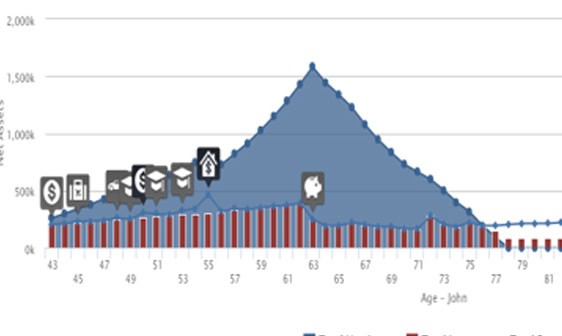
They are currently aged 43 and 41 respectively, plan to work until age 63, and according to Australian averages they can expect to live until 82 and 86.
The blue shaded area to the left of the peak shows how they are building assets while they are working. The icons and rising expenditure line show various expenses during this time which include…
- Overseas holidays every 3 years
- Replacement car every 5 years
- Private high school fees for 3 children from John’s age 49
- Purchasing a boat at age 50
- Home renovations at age 55
The spot where the blue net assets line meets the horizontal axis indicates when John and Sue will run out of money (around age 78). This gives them the opportunity to adjust their planning to achieve a different outcome. For example they could…
- Reduce their expenditure by changing or postponing some goals
- Become more disciplined with their spending (now and in the future)
- Modify their savings levels
- Adjust their investment risk
With this information, John and Sue can make decisions that help them prepare for retirement, balanced with current spending and life experiences.
Imagine having this financial modelling for your income, expenditure, and assets. Like John and Sue, it would help you to see how your current decisions will affect your future finances (and potential lifestyle).
This is just part of the process we use to help you plan for your future, adjust for changing circumstances, and stay on track to getting the outcomes you want. And it’s a key part of our ongoing service at our goal progress meetings.
Note: This case study is illustrative only and is not an estimate of the investment returns you will receive or fees and costs you will incur
How Massey Financial Advice Can Help
At Massey Financial Advice, we provide personalised retirement advice based on your financial position, goals and preferred lifestyle.
Retirement projections and financial modelling
We use financial modelling to estimate how your position may develop over time.
This can help you compare different scenarios, such as:
- retiring at 60, 62 or 65;
- working part-time before retiring fully;
- contributing more to superannuation;
- paying down your mortgage faster;
- selling an investment property;
- making a major purchase;
- changing your investment strategy;
- increasing or reducing your planned retirement spending.
Financial modelling cannot guarantee future outcomes, but it can help you understand the likely effect of different decisions and assumptions. This can provide confidence that you are making an informed decision.
Superannuation contribution strategies
We can review how you are contributing to superannuation and whether there are appropriate opportunities to strengthen your position before retirement.
Any recommendations will take account of your cash flow, contribution limits, tax position, age, eligibility and broader financial goals.
Transition-to-retirement advice
Some people prefer to move gradually from full-time work into retirement.
A transition-to-retirement strategy may involve reducing work hours, adjusting contributions or drawing income from superannuation where eligible. These strategies need to be assessed carefully, as they are not suitable or beneficial in every situation.
Retirement income strategies
We can help you consider how to turn your accumulated assets into a practical retirement income.
This may include reviewing:
- account-based pensions;
- annuities;
- cash reserves;
- investment income;
- withdrawal strategies;
- government benefits;
- the balance between income, growth and capital preservation.
Investment and risk management
We can assess whether your investments remain appropriate as retirement approaches and help align your portfolio with your future income needs, timeframe and comfort with risk.
Cash-flow planning
A retirement plan should consider both regular expenses and larger, less frequent costs.
We can help you estimate your likely retirement spending and consider how your income and assets may support it.
Ongoing review and advice
Retirement planning is not a once-only exercise.
Your goals, investments, family circumstances, health, spending and legislation may change over time. Regular reviews can help keep your strategy aligned with your position and priorities.
Book Your Free Initial Call
See How Today’s Decisions Could Affect Your Retirement
One of the most valuable parts of retirement planning is being able to compare possible choices before acting.
For example, imagine a Brisbane couple in their late 50s who would like to retire within the next five to seven years. They have superannuation, a remaining mortgage, some investments and several major goals for retirement.
They may want to know:
- whether they can retire at 62 rather than 65;
- whether they should contribute more to superannuation or repay debt;
- how much annual income their assets may provide;
- whether they can afford regular travel;
- what may happen if markets fall near retirement;
- whether reducing work hours would affect their long-term position;
- how long their money may last.
By modelling different assumptions and strategies, we can help them see how each decision may influence their retirement outcome.
The purpose is not to create a perfect prediction. It is to replace uncertainty with a more informed plan and give you a clearer basis for making important decisions.
Our Retirement Planning Process
1. Understand your goals
We begin by discussing what you want retirement to look like, when you would like to retire and what concerns or decisions are currently on your mind.
2. Review your financial position
We consider your superannuation, investments, property, debt, income, expenditure, insurance and other relevant financial arrangements.
3. Model your likely retirement outcome
We use financial projections to assess how your current position may develop and whether it is likely to support your preferred retirement lifestyle.
4. Compare different strategies
Where appropriate, we model alternative retirement dates, contribution levels, debt repayments, investment approaches and spending assumptions.
5. Develop your recommendations
We prepare advice based on the strategies that are suitable for your circumstances, goals and priorities.
6. Implement the agreed plan
Once you understand and approve the recommendations, we can assist with implementing the agreed strategy.
7. Review your progress
Retirement plans should be reviewed as your circumstances, priorities and financial environment change.
Planning for Different Stages of Retirement
Your priorities will change as retirement gets closer. Our retirement advice is structured around the stage you have reached.
Ten Years to Retirement
If retirement is still several years away, your focus may be on building superannuation, reducing debt, reviewing investments and understanding whether you are on track.
Visit our Ten Years to Retirement page to learn more about the steps you can take during this important planning period.
Commencing Retirement
If you are preparing to leave work, your focus may shift towards accessing superannuation, creating retirement income, managing cash reserves and adjusting your investment strategy.
Visit our Commencing Retirement page for information about preparing for the transition from employment into retirement.










About Adam Massey
Adam Massey, founder of Massey Financial Advice, is a Certified Financial Planner® with a Bachelor of Business and a Diploma of Financial Planning. He is married to Bron, they have 3 children and Adam has lived in Sydney, Adelaide, Canberra, Port Douglas, London and now Brisbane. He was an active committee member of The Mater Foundation and volunteers at the school tuckshop. In other words, he has more than textbook knowledge – he has the formal training and life experience to help you get the financial outcomes you want – to build wealth for retirement without sacrificing your current lifestyle.
Retirement Planning FAQs
When should I start planning for retirement?
It is generally beneficial to begin planning well before you intend to retire. Starting earlier may give you more time to adjust your savings, superannuation contributions, debt repayments and investment strategy.
However, it is never too late to review your position. Even if retirement is close, professional advice may help you make better-informed decisions about your assets, income and retirement timing.
How much money will I need to retire?
The amount you need will depend on the lifestyle you want, your housing situation, expected expenses, health, travel plans, family commitments and other sources of income.
Rather than relying on a single target figure, it is often more useful to estimate your likely annual spending and model whether your assets can support that level of income over time.
Can I retire before age 65?
Possibly. Your ability to retire before 65 will depend on factors such as your superannuation access age, savings, investments, debt, spending requirements and willingness to adjust your lifestyle.
Financial modelling can help compare different retirement dates and show how retiring earlier may affect your long-term position.
Should I pay off my mortgage or contribute more to superannuation?
Both options can have benefits, and the right balance depends on your circumstances.
Mortgage repayments may provide certainty and reduce your expenses in retirement. Superannuation contributions may offer tax advantages and support long-term investment growth. The decision should also consider contribution limits, interest rates, liquidity and your retirement timeframe.
How will I create an income from my superannuation?
Once eligible, you may be able to use some or all of your superannuation to commence an account-based pension or another retirement income arrangement.
The most appropriate structure will depend on your circumstances, income needs, investment strategy, tax position and eligibility for government benefits.
Will I qualify for the Age Pension?
Age Pension eligibility is subject to age, residency, income and asset requirements.
Some people may qualify for a full or part pension when they retire, while others may become eligible later as their financial position changes. We can help you understand how potential entitlements may fit into your wider retirement plan.
What is a transition-to-retirement strategy?
A transition-to-retirement strategy may allow eligible people to access part of their superannuation while continuing to work.
It may be used to supplement income after reducing work hours or as part of a broader contribution strategy. These arrangements can be complex and are not suitable for everyone, so personal advice is important.
How often should my retirement plan be reviewed?
Your plan should be reviewed when your circumstances change and at regular intervals.
A review may be particularly important after changes to your income, employment, health, family situation, investments, debt, retirement date or relevant legislation.
Why Work With Massey Financial Advice?
Retirement decisions can affect your finances for decades. It is important to work with an adviser who takes the time to understand your circumstances and explain your options clearly.
Adam Massey is a Certified Financial Planner® with a Bachelor of Business and a Diploma of Financial Planning. Brisbane has been his home for more than 20 years, and he works with clients who want practical, personalised advice about retirement and their broader financial future.
Our approach is built around:
- personalised advice rather than generic strategies;
- practical financial modelling;
- plain-language explanations;
- transparent communication;
- long-term support;
- recommendations based on your goals and circumstances.
- We aim to help you understand not only what is being recommended, but why it may improve your position.

Graduate
Australian Institute of Company Directors


What Others Are Saying…
Here is a small sample of what other people say about their experience dealing with Adam.
Take the Next Step Towards Retirement with Confidence
Would you like to understand when you may be able to retire and how much income your current position could provide? Would you like to compare different retirement dates or see how changes to your superannuation, debt or investments may affect your future? Book a complimentary initial call with Massey Financial Advice to discuss your goals and find out whether retirement planning advice may be suitable for you.